Code
Qualified name: manim.mobject.text.code\_mobject.Code
- class Code(code_file=None, code_string=None, language=None, formatter_style='vim', tab_width=4, add_line_numbers=True, line_numbers_from=1, background='rectangle', background_config=None, paragraph_config=None)[source]
Bases:
VMobjectA highlighted source code listing.
Examples
Normal usage:
listing = Code(
    "helloworldcpp.cpp",
    tab_width=4,
    formatter_style="emacs",
    background="window",
    language="cpp",
    background_config={"stroke_color": WHITE},
    paragraph_config={"font": "Noto Sans Mono"},
)
We can also render code passed as a string. As the automatic language detection can be a bit flaky, it is recommended to specify the language explicitly:
Example: CodeFromString 
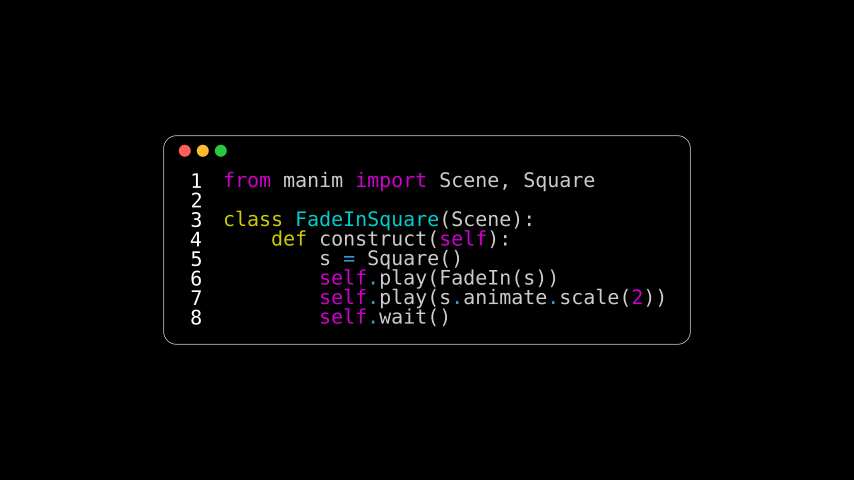
from manim import *

class CodeFromString(Scene):
    def construct(self):
        code = '''from manim import Scene, Square

class FadeInSquare(Scene):
    def construct(self):
        s = Square()
        self.play(FadeIn(s))
        self.play(s.animate.scale(2))
        self.wait()'''

        rendered_code = Code(
            code_string=code,
            language="python",
            background="window",
            background_config={"stroke_color": "maroon"},
        )
        self.add(rendered_code)
class CodeFromString(Scene): def construct(self): code = '''from manim import Scene, Square class FadeInSquare(Scene): def construct(self): s = Square() self.play(FadeIn(s)) self.play(s.animate.scale(2)) self.wait()''' rendered_code = Code( code_string=code, language="python", background="window", background_config={"stroke_color": "maroon"}, ) self.add(rendered_code)- Parameters:
code_file (StrPath | None) – The path to the code file to display.
code_string (str | None) – Alternatively, the code string to display.
language (str | None) – The programming language of the code. If not specified, it will be guessed from the file extension or the code itself.
formatter_style (str | type[Style]) – The style to use for the code highlighting. This can be either the name of a Pygments style or a custom Pygments style class. Defaults to
"vim". A list of all available styles can be obtained by callingCode.get_styles_list(); style classes can be retrieved withCode.get_pygments_style().tab_width (int) – The width of a tab character in spaces. Defaults to 4.
add_line_numbers (bool) – Whether to display line numbers. Defaults to
True.line_numbers_from (int) – The first line number to display. Defaults to 1.
background (Literal['rectangle', 'window']) – The type of background to use. Can be either
"rectangle"(the default) or"window".background_config (dict[str, Any] | None) – Keyword arguments passed to the background constructor. Default settings are stored in the class attribute
default_background_config(which can also be modified directly). Iffill_coloris not specified, it is taken from the selectedformatter_style.paragraph_config (dict[str, Any] | None) – Keyword arguments passed to the constructor of the
Paragraphobjects holding the code, and the line numbers. Default settings are stored in the class attributedefault_paragraph_config(which can also be modified directly). Thecolorsetting is ignored because colors are determined by the selected Pygments style.
Notes
Note
The Pygments style controls the colors of the rendered code, including its default foreground, background, and line number colors. To customize the color scheme, pass a custom Pygments style class via
formatter_stylerather than settingparagraph_config["color"]. See Creating own styles with Pygments for details.For example, a built-in style can be subclassed without importing its style class directly:
from manim import *
from pygments.token import Comment

BaseStyle = Code.get_pygments_style("vim")

class CustomStyle(BaseStyle):
    background_color = "#1e1e1e"
    line_number_color = "#858585"
    styles = {
        **BaseStyle.styles,
        Comment: "italic #6a9955",
    }


class Example(Scene):
    def construct(self):
        rendered_code = Code(
            code_string="print('Hello, world!')  # greeting",
            language="python",
            formatter_style=CustomStyle,
        )

        self.add(rendered_code)
        self.wait(2)
Methods
Return the Pygments style registered under
name.Get the list of all available formatter styles.
Attributes
alwaysCall a method on a mobject every frame.
animateUsed to animate the application of any method of
self.animation_overridescolordefault_background_configdefault_paragraph_configdepthThe depth of the mobject.
fill_colorIf there are multiple colors (for gradient) this returns the first one
heightThe height of the mobject.
n_points_per_curvesheen_factorstroke_colorwidthThe width of the mobject.
codetargetoriginal_id- _original__init__(code_file=None, code_string=None, language=None, formatter_style='vim', tab_width=4, add_line_numbers=True, line_numbers_from=1, background='rectangle', background_config=None, paragraph_config=None)
Initialize self. See help(type(self)) for accurate signature.
- Parameters:
code_file (TypeAliasForwardRef('~manim.typing.StrPath') | None)
code_string (str | None)
language (str | None)
formatter_style (str | type[Style])
tab_width (int)
add_line_numbers (bool)
line_numbers_from (int)
background (Literal['rectangle', 'window'])
background_config (dict[str, Any] | None)
paragraph_config (dict[str, Any] | None)