Typst
Qualified name: manim.mobject.text.typst\_mobject.Typst
- class Typst(typst_code, *, font_size=48, typst_preamble='', color=None, stroke_width=None, font_paths=None, track_baselines=False, should_center=True, height=None, **kwargs)[source]
Bases:
SVGMobjectA mobject rendered from a Typst markup string.
The Typst source is compiled to SVG via the
typstPython package (a self-contained Rust binary extension — no system-level install required) and then imported throughSVGMobject.- Parameters:
typst_code (str) – Raw Typst markup to be compiled. This string is placed verbatim into the body of a minimal Typst document.
font_size (float) – Font size in Manim font-size units (default:
DEFAULT_FONT_SIZE, i.e. 48). The actual scaling is applied after SVG import, matching the approach used bySingleStringMathTex.typst_preamble (str) – Extra Typst code inserted before the body. Useful for
#import,#set, or#showrules. Default:"".color (ManimColor) – The color of the mobject. By default the standard VMobject color (white in dark mode). Overrides the Typst text fill color.
stroke_width (float | None) – SVG stroke width override. If
None(default), the stroke widths from Typst’s SVG output are preserved.font_paths (list[str | Path] | None) – Optional list of additional font directories passed to the Typst compiler (e.g. for custom fonts not installed system-wide).
track_baselines (bool) – Whether to keep enough per-element reference data to recover the current Typst baseline frame for each imported submobject. When enabled,
baseline_framesandget_baseline_frame()can be used to retrieve the current(orig, right, up)positions for the imported SVG elements.should_center (bool) – Whether to center the mobject after import (default
True).height (float | None) – Target height of the mobject. If
None(default), the height is determined byfont_size.**kwargs (Any) – Forwarded to
SVGMobject.
Examples
Example: TypstExample 
from manim import *

class TypstExample(Scene):
    def construct(self):
        formula = Typst(r"$ integral_a^b f(x) dif x $")
        self.play(Write(formula))
class TypstExample(Scene):
    def construct(self):
        formula = Typst(r"$ integral_a^b f(x) dif x $")
        self.play(Write(formula))
References:
TypstExample: TypstTextExample 

from manim import *

class TypstTextExample(Scene):
    def construct(self):
        text = Typst(
            r"*Hello* from _Typst!_",
            font_size=72,
        )
        self.add(text)
class TypstTextExample(Scene):
    def construct(self):
        text = Typst(
            r"*Hello* from _Typst!_",
            font_size=72,
        )
        self.add(text)
References:
TypstMethods
Return the current Typst baseline frame for a tracked submobject.
Attach Typst-specific metadata to imported shape mobjects.
Recolor black submobjects to
self.color.Convert
data-typst-labelattributes toidbefore parsing.Scale the size by a factor.
Select a labeled sub-expression.
Attributes
alwaysCall a method on a mobject every frame.
animateUsed to animate the application of any method of
self.animation_overridesCurrent Typst baseline frames for all tracked leaf submobjects.
colordepthThe depth of the mobject.
fill_colorIf there are multiple colors (for gradient) this returns the first one
The font size of the Typst mobject.
Include baseline tracking in the SVG cache key.
heightThe height of the mobject.
n_points_per_curvesheen_factorstroke_colorwidthThe width of the mobject.
targetoriginal_id- static _get_reference_baseline_frame(shape)[source]
Return the reference
(orig, right, up)frame for a Typst SVG element.The frame is expressed in the same pre-centering coordinate system as the imported submobject points after the element’s own SVG transform has been applied.
- Parameters:
shape (SVGElement)
- Return type:
ndarray | None
- _original__init__(typst_code, *, font_size=48, typst_preamble='', color=None, stroke_width=None, font_paths=None, track_baselines=False, should_center=True, height=None, **kwargs)
Initialize self. See help(type(self)) for accurate signature.
- Parameters:
typst_code (str)
font_size (float)
typst_preamble (str)
color (TypeAliasForwardRef('~manim.utils.color.core.ParsableManimColor') | None)
stroke_width (float | None)
font_paths (list[str | Path] | None)
track_baselines (bool)
should_center (bool)
height (float | None)
kwargs (Any)
- _rebuild_label_aliases()[source]
Rebuild user-facing label aliases from imported SVG ids.
- Return type:
None
- _refresh_svg_stroke_widths()[source]
Refresh pixel stroke widths for Typst-authored SVG strokes.
SVG stroke widths are specified in the SVG’s local coordinate system, while Manim stroke widths are pixel-based. For Typst-authored strokes such as fraction bars or underlines, rescale them according to the current geometric scale of the imported element so their visual weight stays proportional to the rest of the expression.
- Return type:
None
- _user_label_keys()[source]
Return the label keys that were created from
data-typst-labelattributes (filtering out internal Typst group IDs and auto-numbered groups).- Return type:
list[str]
- property baseline_frames: list[tuple[ndarray, ndarray, ndarray]]
Current Typst baseline frames for all tracked leaf submobjects.
- property font_size: float
The font size of the Typst mobject.
- get_baseline_frame(submobject)[source]
Return the current Typst baseline frame for a tracked submobject.
The returned tuple contains the current positions of
(orig, right, up). These are recovered from the stored reference frame and the submobject’s current affine position in the scene.- Parameters:
submobject (VMobject)
- Return type:
tuple[ndarray, ndarray, ndarray]
- get_mob_from_shape_element(shape)[source]
Attach Typst-specific metadata to imported shape mobjects.
- Parameters:
shape (SVGElement)
- Return type:
VMobject | None
- property hash_seed: tuple
Include baseline tracking in the SVG cache key.
- init_colors(propagate_colors=True)[source]
Recolor black submobjects to
self.color.Typst renders text in black (
fill="#000000") by default. This mirrors the approach ofSingleStringMathTex.init_colors(): any submobject whose color is black is recolored toself.color, while explicitly colored submobjects (non-black) are preserved.- Parameters:
propagate_colors (bool)
- Return type:
Self
- modify_xml_tree(element_tree)[source]
Convert
data-typst-labelattributes toidbefore parsing.Typst’s SVG renderer emits
data-typst-labelon<g>elements that carry a label (created via#box(body) <label>). Thesvgelementslibrary propagates customdata-*attributes from parent groups to all children, making them unusable as unique group keys.idattributes, on the other hand, are not inherited.This method walks the XML tree and promotes every
data-typst-labeltoid(on<g>elements only), so thatget_mobjects_from()can pick them up via its existingid-based grouping logic.- Parameters:
element_tree (ElementTree)
- Return type:
ElementTree
- scale(scale_factor, scale_stroke=False, *, about_point=None, about_edge=None)[source]
Scale the size by a factor.
Default behavior is to scale about the center of the vmobject.
- Parameters:
scale_factor (float) – The scaling factor \(\alpha\). If \(0 < |\alpha| < 1\), the mobject will shrink, and for \(|\alpha| > 1\) it will grow. Furthermore, if \(\alpha < 0\), the mobject is also flipped.
scale_stroke (bool) – Boolean determining if each submobject’s outline is scaled when the object is scaled. If enabled, each submobject keeps its relative stroke width (for example, a submobject with a 2px outline scaled by a factor of .5 will have a 1px outline, while a submobject with 0px stroke remains at 0px).
kwargs – Additional keyword arguments passed to
scale().about_point (ndarray | None)
about_edge (ndarray | None)
- Returns:
self- Return type:
VMobject
Examples
Example: MobjectScaleExample 
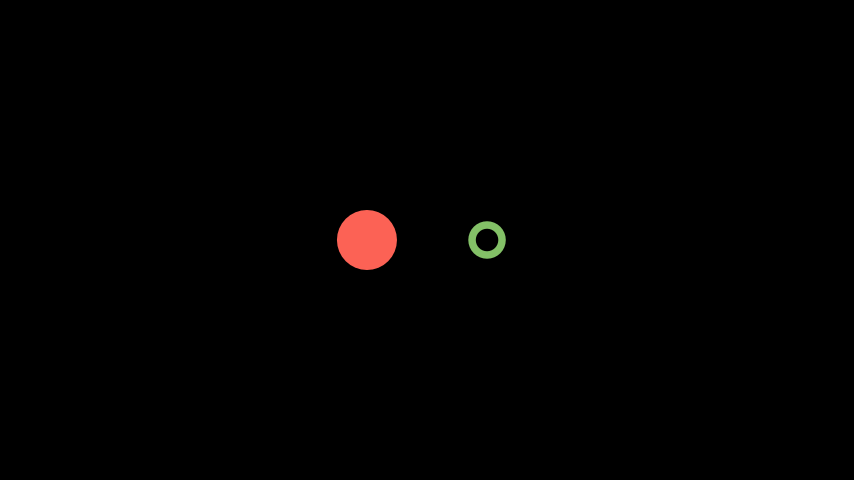
from manim import *

class MobjectScaleExample(Scene):
    def construct(self):
        c1 = Circle(1, RED).set_x(-1)
        c2 = Circle(1, GREEN).set_x(1)

        vg = VGroup(c1, c2)
        vg.set_stroke(width=50)
        self.add(vg)

        self.play(
            c1.animate.scale(.25),
            c2.animate.scale(.25,
                scale_stroke=True)
        )
class MobjectScaleExample(Scene):
    def construct(self):
        c1 = Circle(1, RED).set_x(-1)
        c2 = Circle(1, GREEN).set_x(1)

        vg = VGroup(c1, c2)
        vg.set_stroke(width=50)
        self.add(vg)

        self.play(
            c1.animate.scale(.25),
            c2.animate.scale(.25,
                scale_stroke=True)
        )
See also
move_to()
- select(key)[source]
Select a labeled sub-expression.
Labels are created in the Typst source either manually via the
manimgrphelper or automatically through the{{ }}double-brace notation inMathTypst.- Parameters:
key (str | int) – A label name (
str) matching adata-typst-labelin the SVG, or an integer index into the auto-numbered{{ }}groups (_grp-0,_grp-1, …).- Returns:
The submobjects corresponding to the selected group.
- Return type:
- Raises:
KeyError – If no group with the given label exists.
IndexError – If an integer index is out of range.
Examples
Example: TypstSelectExample 

from manim import *

class TypstSelectExample(Scene):
    def construct(self):
        eq = MathTypst(
            "{{ a + b : num }} / {{ c : den }} = {{ lambda }} {{ x }}"
        )
        eq.select("num").set_color(RED)  # "a + b"
        eq.select("den").set_color(BLUE) # "c"
        eq.select(0).set_color(YELLOW)   # "lambda" (auto-numbered: "grp-0")
        eq.select(1).set_color(GREEN)    # "x" (auto-numbered: "grp-1")

        self.add(eq)
class TypstSelectExample(Scene):
    def construct(self):
        eq = MathTypst(
            "{{ a + b : num }} / {{ c : den }} = {{ lambda }} {{ x }}"
        )
        eq.select("num").set_color(RED)  # "a + b"
        eq.select("den").set_color(BLUE) # "c"
        eq.select(0).set_color(YELLOW)   # "lambda" (auto-numbered: "grp-0")
        eq.select(1).set_color(GREEN)    # "x" (auto-numbered: "grp-1")

        self.add(eq)

